At The Mercy Of Our Perceptions . . .

Canadian edition of OUR DAILY BREAD

Well, OUR DAILY BREAD is out in Canada now, and I’m delighted with the Canadian edition.  Beautiful new cover, deckle edges, French flaps.  I think Harper Collins has done a terrific job, and so far the response from readers has been good.

Which means, of course, I have to start thinking about what I’m going to write next.  Actually, I’ve just finished a new novel, a speculative look at what a day (okay, a REALLY BAD day) in the life of a woman very much like me might look like, had I not stopped drinking seventeen years ago.

10 Truths for Emerging Writers (hint: think slow)

I heard from an emerging writer recently who said she’d been crushed, devastated, destroyed by the feedback she’s received on her book, which she recently self-published, and by the lack of sales.  She was so convinced it was brilliant. Now she feels as though readers are idiots or else she’s utterly deluded.  Either way, she’s done.  Quit.  She won’t write again.

Oh, dear.

Back at the beginning of time, before self-publishing became so popular, writers developed over years, sometimes decades.  A writer became a writer by spending a lot of time reading, figuring out how writers he or she admired crafted wonderful books and, in turn, spending a fair period of time (often years) learning to do this him or herself.

“Are you there already?”

Writing a novel is, of course, a mad undertaking.  It begins with an effervescent, glimmering vision of perfection, which sets the writer off on her ink-stained quest, assured that THIS time she will reproduce the vision exactly, and as scintillatingly as it first appeared. This mirage is quickly followed by the mossy-toothed skull of doubt, and then long months of slog, wherein the writer is often only propelled forward by a dogged sense of duty, and fatalism.  In other words — we keep following the sentences, one after mediocre one, in the hopes of landing somewhere, if not glimmering and effervescent, then at least reasonably well appointed. We also keep going because, really, we don’t do anything else even remotely well and if we we don’t write about what’s bothering us, we tend to be even more annoying to live with (my Best Beloved assures me) than we are when we’re embedded in slog.

Bailey Day

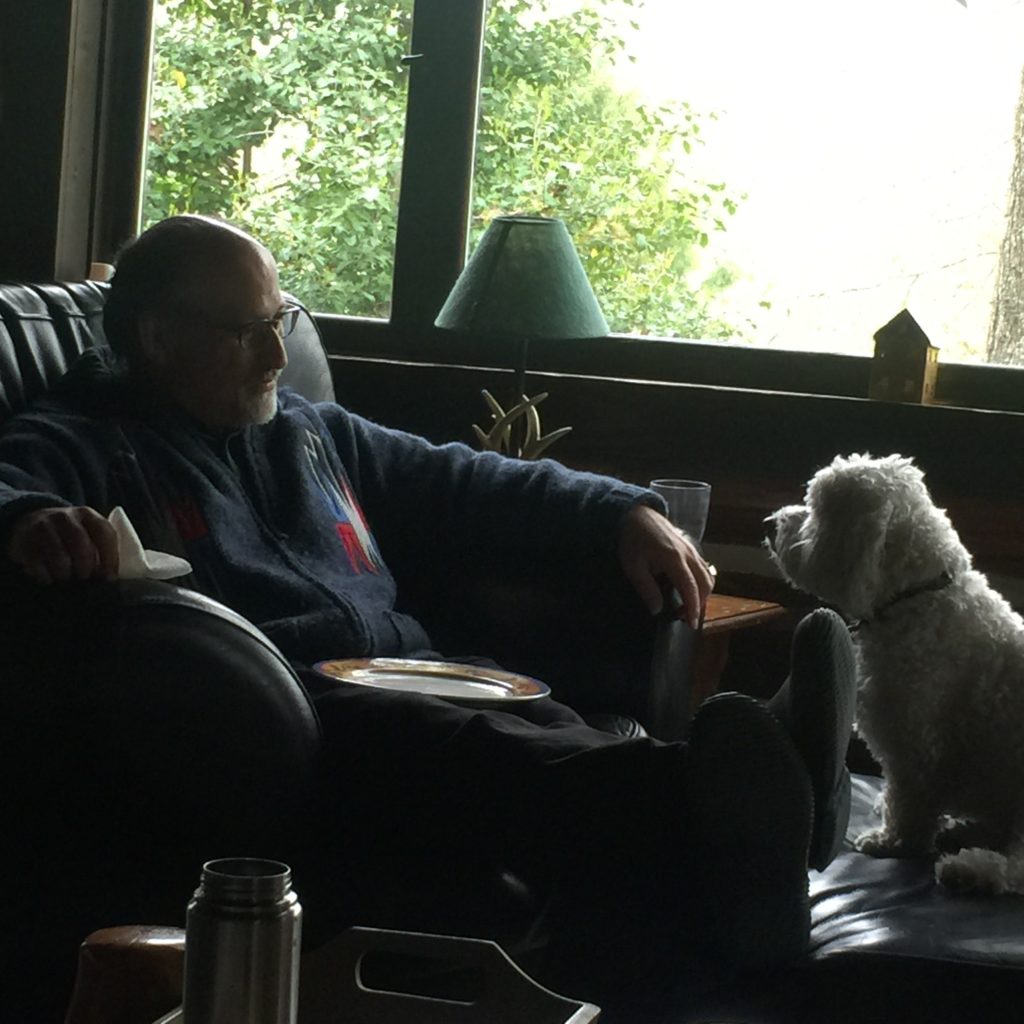
Bailey-the-Rescuepoo

Today is the one-year anniversary of the day Bailey-the-Rescuepoo came to live with My Best Beloved and me.

The Best Beloved is in Europe just now, but he sent an email requesting I give Bailey a few extra treats for him on what he calls “Bailey Day.”  He said he can’t believe how his heart has opened up in a whole new way.

Dogs are like that — they’re kind of magic.

Writing lessons — with laughter

The Best Beloved, Lauren B. Davis & Dany Laferriere having a Unliterary Dinner

Last night The Best Beloved and I had dinner with Haitian/Quebec writer Dany Laferriere.  Dany has written a vast number of books, including the well known and critically praised “How To Make Love To A Negro Without Getting Tired.”  His new book, a brilliant memoir entitled “The Return” has been short-listed for the 2011 Giller Prize. I’d met Dany at other events over the years, but this is the first time we’ve been able to spend any real time together.  Both The Best Beloved and I like him very much.  The conversation turned, as it is likely to do with writers, to the wonders and difficulties of the writer’s life.

Psychology Today article

I have an article about forgiveness up on the “Psychology Today” website . . . . many thanks to my friend, wonderful writer Ethan Gilsdorf, for making this happen.  You can read the piece by clicking here.  thanks!

I Dreamed A Dream

Briar Rose Sleeping by Edward Burne-Jones

Last night I dreamed I’d written the perfect story.  I came half-awake, filled with a sense of contentment.  I even knew what the story was about.  It was about a man who was mediating between two warring tribes when it came to him he had the answer to their conflict, which involved both sides saying exactly the same thing, but using symbols so wildly different one side couldn’t understand the other.  My protagonist stood on a great wall and tossed a bowl to the people on one side.  He then tossed something to the people on the other.  I wish I could remember what it was, and I want to say a wand, crozier or scepter, but that seems so full of blatant Freudian symbolism I’d rather not.  Whatever it was, each side thought the item had come from their enemy, and yet when they saw it, they were stunned — contrary to what they’d believed, their enemy had given them exactly what they needed, and apparently understood them perfectly.  Peace is restored.

Opening the stranger door

So, while I’m waiting for the publication of my new book, I’m turning back to the work-in-progress, which has me in something of a twist.

It’s been a relief, frankly, to put it aside for a couple of months while I concentrate on the ‘bidness’ of publishing.  However, The Big Dog now wants to be walked, and in lieu of having it pee on the carpet and eat my furniture, I am paying it all the attention I can.

Bright Spots

Cover, "Our Daily Bread"

I am so grateful for the support I’ve received for my new novel, Our Daily BreadThomas E. Kennedy, author of The Copenhagen Quartet, Duff Brenna, author of Too Cool, The Book of Maime and The Holy Book of the Beard (among others), and Dexter Palmer, author of The Dream of Perpetual Motion, have all donated blurbs, as has the wonderful Canadian author, Jane Urquhart.  Jane says,

“Our Daily Bread is a compelling narrative set in a closely observed, sometimes dark, but ultimately life-enhancing landscape. Lauren B. Davis’ vivid prose and empathetically developed characters will remain in the reader’s mind long after the final chapter has been read. “
—Jane Urquhart, prize winning author of Away and The Stone Carvers

The Things We Carry

As some of you know, my ninety year old mother has had some pretty serious health problems lately and, as her only living relative, the responsibility for her care falls on me, as does the responsibility for cleaning out her condo.

Few things in life are as daunting and emotionally exhausting as cleaning out an elderly parent’s home.  My mother’s condo, which is a lovely bright and airy space with a pretty, sparkling living room and kitchen, nonetheless hid a nasty little hoarding secret.  I feel rather guilty that when I visited her I didn’t insist on looking more closely into the private spaces — drawers and closets, bathrooms and her bedroom.  Perhaps if I had I would have realized sooner something was terribly wrong.